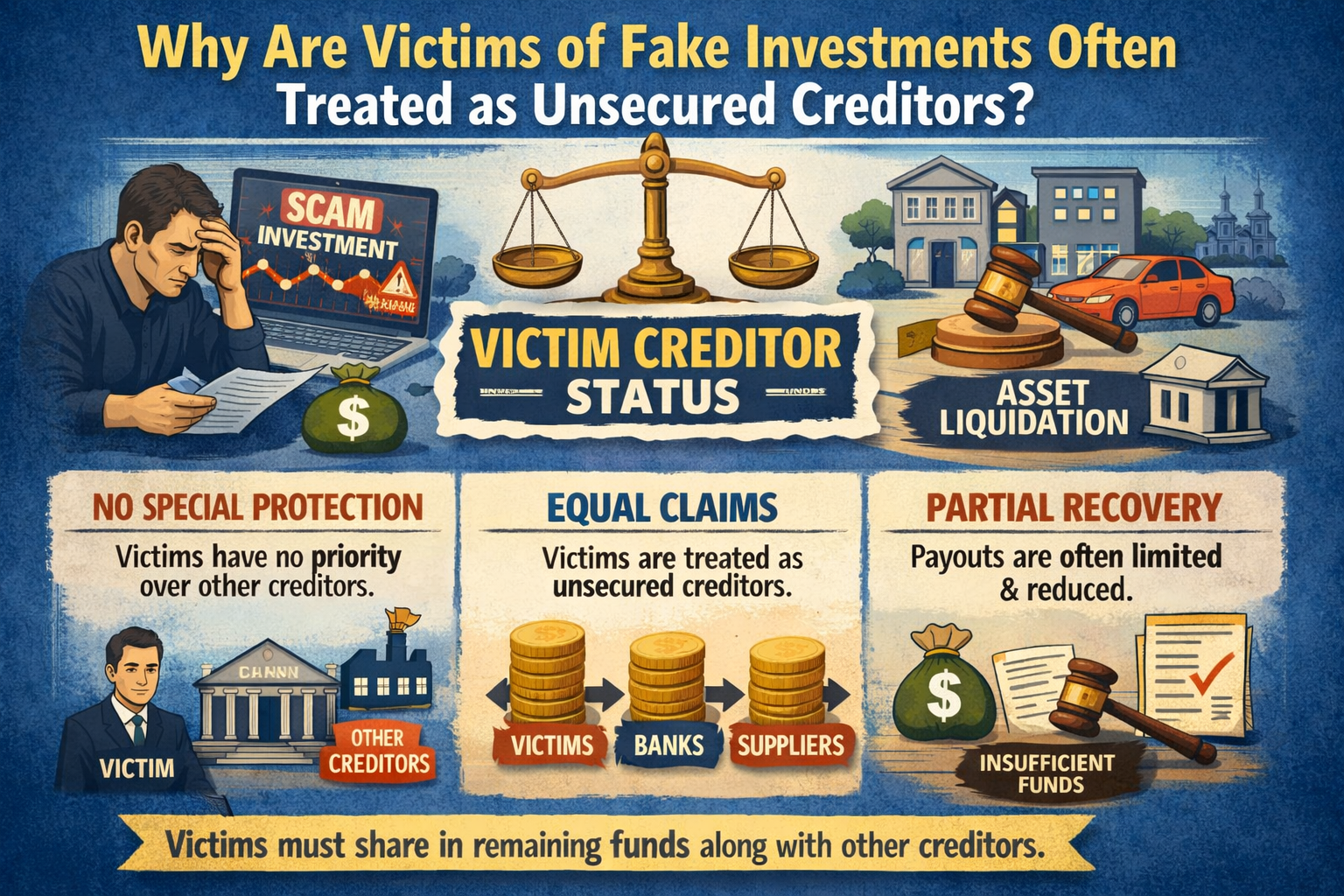
This is a major criticism of how parts of the U.S. legal system address fraud recoveries, particularly in bankruptcy, receivership, Ponzi scheme collapses, and civil forfeiture proceedings.
Why are victims often treated as unsecured creditors?
Courts generally do not believe victims are responsible, which aligns with the legal reasoning. Rather, the law often asks the following:
“Who has a legally recognized property interest in the remaining assets?”
Once money has been transferred to a fraudster, the victim’s original ownership interest may be considered extinguished unless they can specifically trace their property into an identifiable asset.
The result is
- Secured creditors (banks with mortgages, liens, and security interests) get priority.
- Government tax claims may get priority.
- Administrative costs get priority.
- Victims who cannot specifically trace assets are frequently grouped as unsecured creditors.
Often, the court views the victim as having:
“A claim against the fraudster”
rather than
“Ownership of the remaining assets.”
That distinction is what often pushes victims into unsecured creditor status.
How common is this distinction?
Extremely common.
Examples include:
Bernard Madoff Ponzi Scheme
Thousands of victims were not treated as owners of specific assets.
Instead:
- A customer property pool was created.
- Recoveries were distributed proportionally.
- Some investors recovered substantial amounts.
- Others waited more than a decade.
Stanford Financial Fraud
Victims became creditors of the receivership estate.
The court had to determine the following:
- Who qualified as a victim.
- How claims would be calculated.
- Whether cash-in/cash-out or account statement values would be used.
FTX Bankruptcy
One of the largest modern examples.
Customers argued:
“Those assets are ours.”
The bankruptcy framework initially treated customers as creditors of the estate.
This question became one of the most controversial issues in the case.
Crypto scam receiverships
In many crypto fraud cases:
- Wallets are pooled.
- Assets are mixed.
- Tracing becomes difficult.
Courts frequently conclude the following:
“All victims should share pro rata.”
rather than attempting precise ownership reconstruction.
Why does this feel unfair to victims?
Because victims often see a clear moral reality:
“That was my money.”
The legal system often sees a different question:
“Can you prove that this particular asset is your property?”
Those are not always the same thing.
For example:
Victim A loses $500,000.
The fraudster mixes their funds with those of 500 other victims.
Fraudster buys Bitcoin.
Years later, the Bitcoin is seized.
The court may conclude the following:
- Nobody can prove which satoshis belonged to whom.
- Therefore, all victims share proportionally.
The victim feels ownership.
The court sees a commingled asset pool.
How many judges have approved this approach?
Hundreds.
Not because judges are anti-victim.
Rather, because judges are applying the following:
- Bankruptcy Code priorities.
- Receivership law.
- Constructive trust doctrines.
- Property tracing requirements.
- Federal forfeiture statutes.
Most federal judges have limited discretion to rewrite these rules.
The criticism is often directed at the statutes themselves rather than the judges.
What changes would help victims?
Several reforms are regularly proposed.
1. Victim-first priority class
Congress could create a special category:
“Fraud Victim Priority Claims”
ranking ahead of ordinary unsecured creditors.
This approach would be similar to how wage claims receive special treatment.
Many victim advocates support this idea.
2. Presumption of ownership
Current law often requires victims to trace assets.
Congress could create:
“Rebuttable presumption that recovered fraud proceeds belong to victims.”
That would shift the burden away from victims.
3. Separate treatment for induced transfers
Current law often treats the following:
- Voluntary transfers
- Fraud-induced transfers
too similarly.
Victims argue:
“I never intended to gift my money to a criminal.”
A statutory distinction could recognize that fraud destroys meaningful consent.
4. Stronger constructive trust protections
Courts currently apply constructive trust doctrines cautiously.
Congress could expand them for:
- Investment fraud.
- Elder fraud.
- Cryptocurrency fraud.
- Romance scams.
This approach would allow more victims to claim ownership rather than creditor status.
5. Victim compensation funds
The government already uses this model in some contexts.
Examples include compensation funds created after major frauds or disasters.
A national fraud recovery fund could:
- Pay victims sooner.
- Pursue recovery later.
- Reduce years of litigation.
What about forfeiture cases?
This issue is especially controversial in crypto forfeiture cases.
When the government seizes cryptocurrency linked to fraud, there are often three competing views:
- Government view:
- Asset is forfeitable.
- Victim view:
- Asset belongs to victims.
- Traditional property-law view:
- Victims may only hold creditor claims.
The outcome depends heavily on:
- Tracing evidence.
- Statutory framework.
- Whether a claimant can establish a superior interest.
This issue is one reason many fraud victims strongly oppose being categorized as mere unsecured creditors.
Should Congress revisit this issue?
Many legal scholars, victim advocates, and fraud recovery specialists would say yes.
The growth of:
- International investment fraud,
- Pig-butchering scams,
- Cryptocurrency fraud,
- Online investment platforms,
has exposed weaknesses in legal frameworks that largely predate modern digital fraud.
A common reform proposal is the following:
Victims of proven fraud should not automatically fall into the same category as ordinary unsecured creditors who knowingly took commercial risk.
That is probably the central policy debate.
The argument is that a bank lending money to a company and a retiree tricked into transferring life savings to a fake investment platform are fundamentally different situations and should not necessarily be treated identically under recovery laws.
From a policy perspective, that distinction is increasingly receiving attention as crypto-fraud recoveries and large-scale international scam cases continue to grow.
If you have been impacted by crypto fraud, contact Digital Defenders Group for assistance.
No responses yet