Introduction
Cryptocurrency has transformed the way people store, transfer, and invest money. Bitcoin, Ethereum, stablecoins, decentralized finance, non-fungible tokens, and tokenized crypto assets have created an entirely new financial ecosystem that operates independently of traditional banking institutions.
However, cryptocurrency ownership differs fundamentally from owning assets held in a conventional bank account. Banks provide fraud departments, account recovery procedures, transaction disputes, and centralized customer support. Cryptocurrency, by contrast, often places complete responsibility in the hands of the asset owner.
This shift creates both opportunities and risks.
Cryptocurrency transactions are usually irreversible. Wallets can be accessed from anywhere in the world. Private keys can authorize the movement of millions of dollars in assets. If those keys are compromised, recovery may be impossible.
The security of cryptocurrency therefore depends on preparation, education, operational discipline, and risk management.
This guide explores the most effective methods for protecting digital assets from theft, fraud, technical failures, and human error.
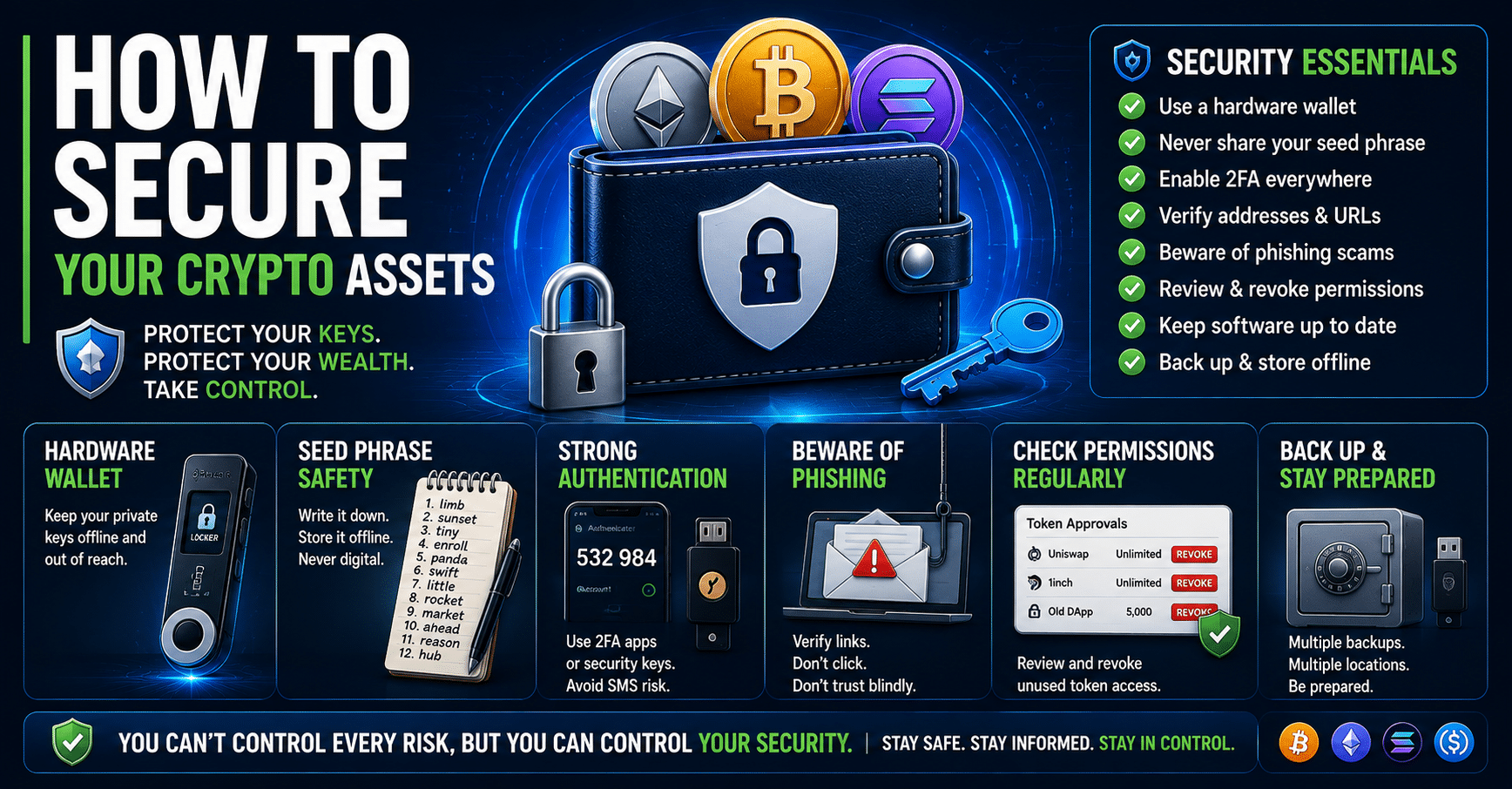
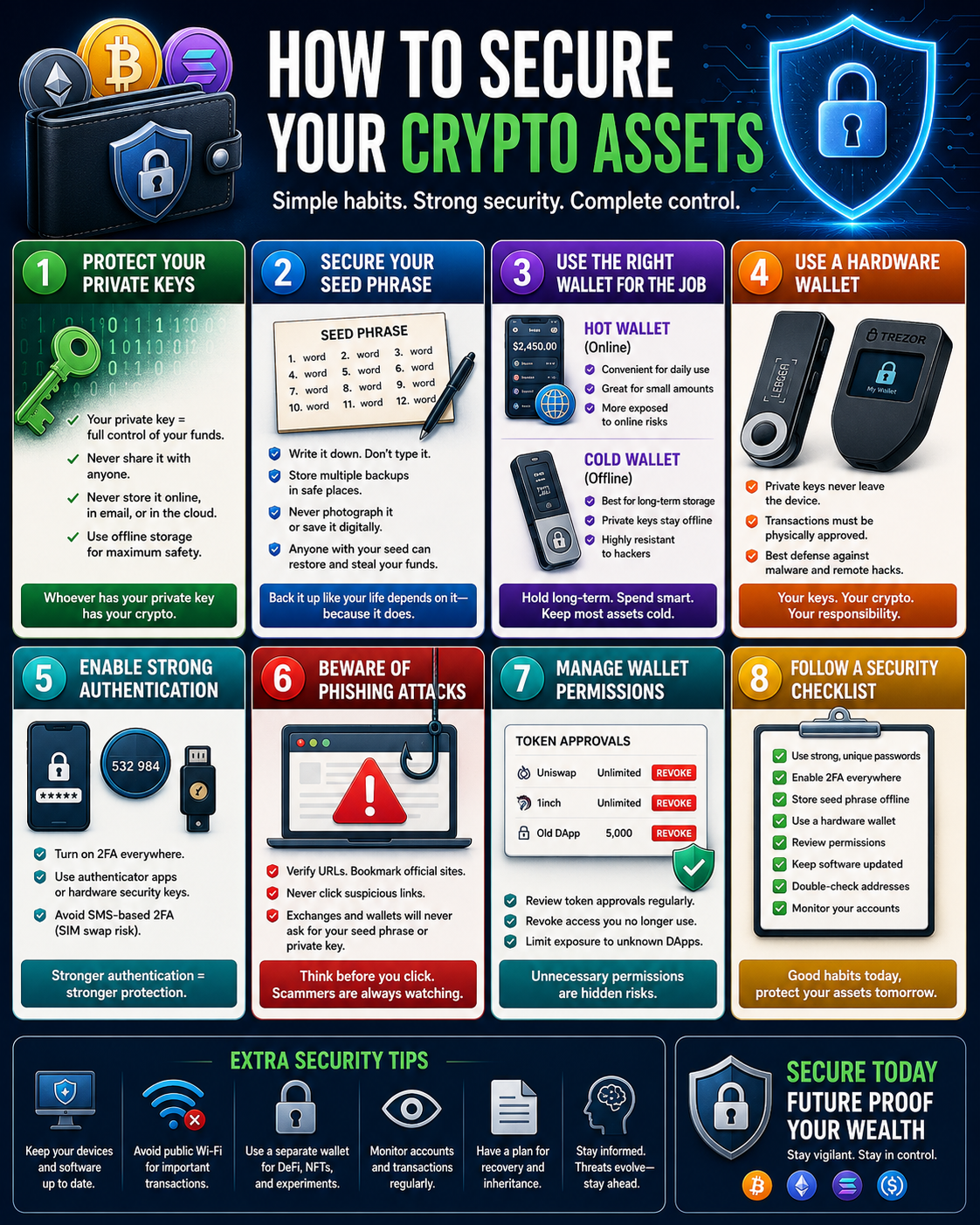
This guide will help you understand how to secure your crypto assets effectively.
Understanding Cryptocurrency Ownership
One of the most important principles in cryptocurrency is understanding what ownership actually means.
Cryptocurrencies are not stored inside a wallet application.
Instead, ownership is determined by cryptographic keys.
Every cryptocurrency wallet contains:
- Public keys
- Private keys
- Wallet addresses
- Digital signatures
The public key generates the wallet address that can be shared with others.
The private key proves ownership and authorizes transactions.
Anyone who gains access to the private key gains control over the associated assets.
This principle is summarized by one of the most widely quoted phrases in cryptocurrency:
“Not your keys, not your coins.”
Protecting Private Keys
Private keys should be treated like the master keys to a bank vault.
Unfortunately, many users underestimate their importance.
Private keys should never be:
- Shared through email
- Sent through messaging applications
- Stored in cloud drives
- Saved in screenshots
- Uploaded to online note-taking applications
- Entered into websites
A private key should only exist inside a trusted wallet environment where your crypto assets are safe.
If someone requests your private key, they are almost certainly attempting to steal your assets.
Understanding Recovery Seed Phrases
Most cryptocurrency wallets generate a recovery seed phrase.
These phrases usually contain:
- 12 words
- 18 words
- 24 words
The seed phrase can completely restore a wallet.
This means that anyone possessing the recovery phrase can rebuild the wallet and transfer every associated asset.
Many investors lose cryptocurrency because they:
- Store the phrase in cloud storage
- Save it in email
- Photograph it with a smartphone
- Keep only one copy
- Share it with support agents
Best practices include:
- Writing the phrase on paper
- Creating multiple backups
- Storing backups in separate secure locations
- Protecting backups from fire and water damage
The recovery phrase should never be digitized unless absolutely necessary.
Hot Wallets and Cold Wallets
Cryptocurrency wallets generally fall into two categories.
Hot Wallets
Hot wallets remain connected to the internet.
Examples include:
- MetaMask
- Trust Wallet
- Phantom
- Coinbase Wallet
Advantages include:
- Convenience
- Fast transactions
- DeFi integration
- NFT support
Disadvantages include:
- Greater exposure to cyberattacks
- Browser vulnerabilities
- Malware risks
Cold Wallets
Cold wallets store private keys offline.
Examples include:
- Ledger
- Trezor
- Coldcard
- Keystone
Advantages include:
- Significantly improved security
- Protection from remote attacks
- Better long-term storage
Disadvantages include:
- Less convenience
- Additional hardware costs
- Increased responsibility for recovery procedures
Many experienced investors maintain both types of wallets.
Use a Hardware Wallet for Long-Term Holdings
Hardware wallets represent one of the most effective security investments available.
Private keys never leave the device.
Transactions must be physically approved.
Even if the connected computer becomes infected, the private keys remain isolated.
Best practices include:
- Purchasing directly from manufacturers
- Verifying device authenticity
- Initializing the wallet personally
- Updating firmware regularly
Avoid purchasing hardware wallets from unknown online marketplaces.
Tampered devices have been used in previous attacks.
Enable Strong Authentication
Passwords alone are insufficient.
Every exchange account should use two-factor authentication.
Authentication methods include:
SMS Authentication
Advantages:
- Easy to configure
Disadvantages:
- Vulnerable to SIM-swapping attacks
Authenticator Applications
Examples:
- Google Authenticator
- Microsoft Authenticator
- Authy
Advantages:
- Stronger protection
Hardware Security Keys
Examples:
- YubiKey
Advantages:
- Industry-leading protection
Hardware security keys provide one of the strongest forms of account authentication.
Use Unique Passwords
Password reuse remains one of the most common security mistakes.
If one account is compromised, every account sharing that password becomes vulnerable.
A password should be:
- Unique
- Long
- Random
- Complex
Password managers simplify this process.
Examples include:
- Bitwarden
- 1Password
- KeePass
Strong password management dramatically reduces risk.
Beware of Phishing Attacks
Phishing attacks attempt to trick users into revealing credentials.
Examples include:
- Fake exchanges
- Fake wallet websites
- Fraudulent emails
- Malicious advertisements
Common warning signs include:
- Misspelled domains
- Urgent language
- Unexpected verification requests
- Unsolicited support messages
Never click links in unexpected emails.
Whenever possible:
- Type addresses manually
- Use bookmarks
- Verify certificates
- Confirm URLs carefully
Verify Smart Contracts
Not every smart contract is trustworthy.
Before connecting a wallet:
- Verify the website
- Review audits
- Confirm contract addresses
- Check community feedback
Malicious contracts can:
- Drain wallets
- Transfer tokens
- Lock assets
- Approve unauthorized transactions
Always read transaction requests carefully.
Review Token Approvals
Many decentralized applications request token permissions.
Some approvals allow unlimited access.
Over time, forgotten permissions can create unnecessary risks.
Users should regularly:
- Review token approvals
- Revoke unused permissions
- Disconnect abandoned applications
Routine maintenance significantly reduces exposure.
Separate Wallets by Purpose
Compartmentalization improves security.
Consider maintaining:
Cold Wallet
Purpose:
Long-term holdings
Trading Wallet
Purpose:
Exchange transactions
DeFi Wallet
Purpose:
Experimental applications
NFT Wallet
Purpose:
Digital collectibles
Separating activities limits the impact of individual compromises.
Secure Your Computer
Wallet security begins with device security.
Recommendations include:
- Keep operating systems updated
- Install security patches
- Use reputable antivirus software
- Remove unnecessary applications
- Avoid pirated software
A compromised computer can expose every connected wallet.
Secure Your Mobile Devices
Smartphones frequently access cryptocurrency accounts.
Protect them by:
- Enabling biometric authentication
- Updating software
- Installing applications only from official stores
- Disabling unnecessary permissions
- Encrypting local storage
Mobile security deserves the same attention as desktop security.
Protect Against SIM-Swapping
SIM-swapping attacks can bypass SMS-based authentication.
Protect yourself by:
- Adding account PINs
- Using authenticator applications
- Avoiding public disclosure of phone numbers
- Securing primary email accounts
Your email account should be considered a critical security asset.
Avoid Public Wi-Fi
Public networks introduce additional risks.
Avoid cryptocurrency transactions while connected to:
- Airports
- Hotels
- Cafes
- Public hotspots
If necessary:
- Use a trusted VPN
- Avoid wallet interactions
- Delay transactions until using a secure connection
Be Cautious with Browser Extensions
Browser extensions can introduce vulnerabilities.
Only install extensions from trusted sources.
Avoid:
- Unverified wallets
- Unknown cryptocurrency tools
- Suspicious add-ons
Extensions can potentially monitor browsing activity and manipulate transactions.
Research Before Investing
Scams often exploit emotion.
Warning signs include:
- Guaranteed returns
- Pressure to invest
- Celebrity endorsements
- Anonymous development teams
Always conduct independent research.
Review:
- White papers
- Audits
- Token distribution
- Liquidity
- Development activity
Never rely solely on influencers.
Monitor Wallet Activity
Blockchain explorers allow users to monitor transactions.
Regular monitoring helps identify:
- Unauthorized transfers
- Suspicious approvals
- Unexpected token movements
Early detection can prevent additional losses.
Create an Estate Plan
Cryptocurrency introduces unique inheritance challenges.
Consider:
- Recovery phrase instructions
- Beneficiary information
- Legal documentation
- Secure storage procedures
Without preparation, assets may become permanently inaccessible.
Create a Security Checklist
Daily:
- Verify websites
- Confirm addresses
Weekly:
- Review wallet activity
Monthly:
- Check approvals
- Update software
Quarterly:
- Verify backups
- Review security settings
Annual:
- Test recovery procedures
Security should become routine rather than reactive.
Common Mistakes
Avoid these errors:
- Sharing seed phrases
- Reusing passwords
- Leaving large balances on exchanges
- Clicking unknown links
- Using excessive trust
- Ignoring software updates
- Connecting wallets indiscriminately
Most losses result from preventable mistakes.
If You Suspect a Compromise
Act immediately.
- Transfer unaffected assets.
- Revoke approvals.
- Change passwords.
- Enable stronger authentication.
- Document evidence.
- Contact exchanges.
- Report suspicious activity.
Time matters.
Conclusion
Cryptocurrency security depends on education, preparation, and discipline.
No technology can completely eliminate risk, but effective security practices can significantly reduce exposure.
Hardware wallets, strong authentication, secure backups, compartmentalized wallets, software maintenance, careful research, and ongoing vigilance create multiple layers of protection.
The most successful cryptocurrency investors do not simply focus on generating returns.
They focus equally on preserving assets.
The digital asset landscape continues to evolve, and attackers continue to develop increasingly sophisticated techniques.
Your strongest defense remains the same:
Protect your keys.
Verify everything.
Never stop learning.
If you have been impacted by crypto fraud, contact Digital Defenders Group for assistance.
No responses yet