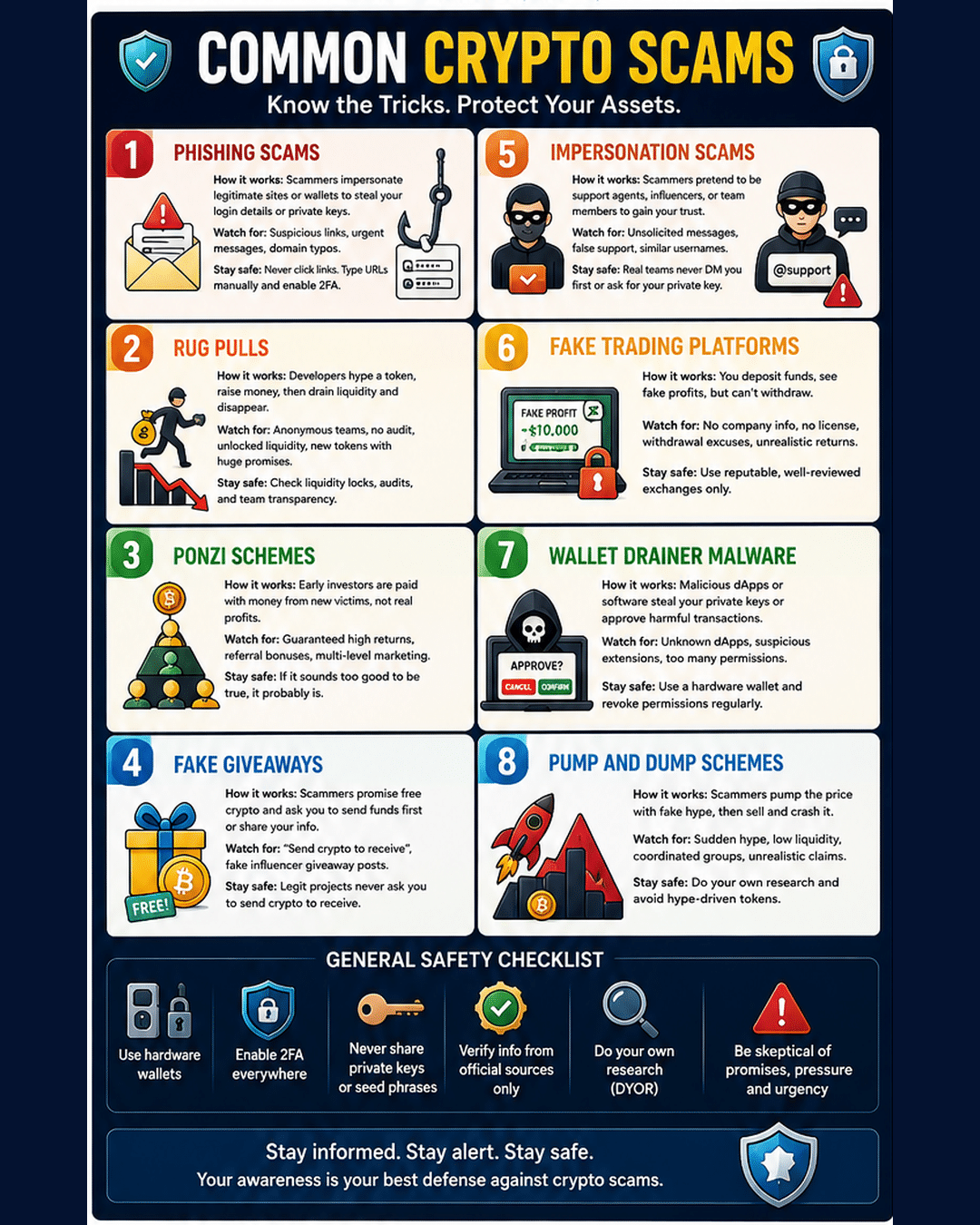
COMMON CRYPTO SCAMS: HOW THEY WORK AND HOW TO PROTECT YOURSELF
Introduction
Cryptocurrency has created new opportunities for investing, payments, decentralized finance, digital ownership, and global commerce. However, the same characteristics that make cryptocurrency attractive—speed, borderless transactions, pseudonymity, self-custody, and limited transaction reversibility—also make it appealing to scammers.
Unlike many traditional payment methods, blockchain transfers generally cannot be cancelled after confirmation. There may be no bank, payment processor, or central authority capable of reversing the transaction. Once cryptocurrency has been transferred to a scammer-controlled wallet, recovering it can be extremely difficult.
Crypto scams are not limited to inexperienced users. Sophisticated investors, technology professionals, businesses, and institutions have also suffered losses. Modern fraud operations may use convincing websites, professional customer-service teams, fabricated account dashboards, artificial intelligence, social engineering, romance manipulation, fake legal documents, and carefully rehearsed investment narratives.
Understanding how common crypto scams operate is therefore essential for anyone who buys, holds, trades, transfers, or manages digital assets.
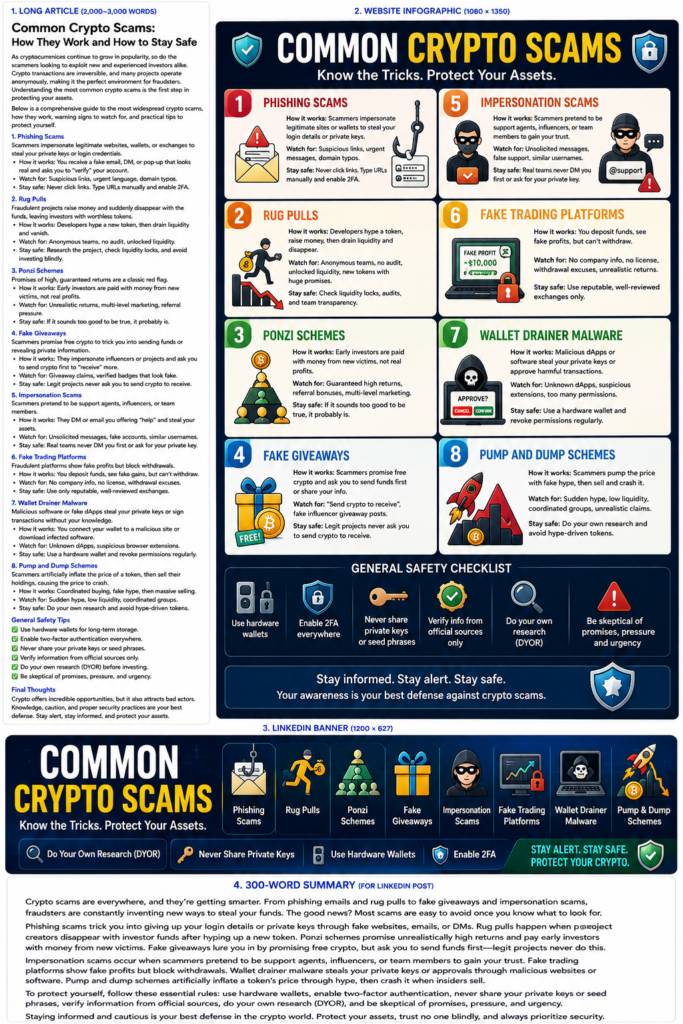
WHY CRYPTOCURRENCY ATTRACTS SCAMMERS
Several features of cryptocurrency create opportunities for fraud.
IRREVERSIBLE TRANSACTIONS
Most confirmed blockchain transactions cannot simply be recalled. If a user sends funds to the wrong address or authorizes a malicious transaction, there is usually no automatic chargeback process.
GLOBAL ACCESS
Scammers can target victims in other countries without meeting them physically. Communications may take place through email, social media, messaging applications, online forums, or dating platforms.
PSEUDONYMOUS WALLETS
Blockchain transactions are publicly visible, but wallet addresses do not automatically reveal the real-world identity of their owners.
TECHNICAL COMPLEXITY
Terms such as seed phrase, gas fee, liquidity pool, staking, smart contract, bridge, validator, token approval, and decentralized exchange can confuse newer users. Scammers exploit this knowledge gap.
MARKET VOLATILITY
Rapid price increases create fear of missing out. Victims may act quickly because they believe an opportunity will disappear.
SELF-CUSTODY
Self-custody gives users direct control of their assets, but it also makes them responsible for protecting private keys and recovery phrases.
- PHISHING SCAMS
Phishing is one of the most common methods used to steal cryptocurrency.
A phishing scam attempts to trick the victim into revealing:
- Exchange login credentials.
- Private keys.
- Recovery seed phrases.
- Two-factor authentication codes.
- Wallet connection permissions.
- Personal identity information.
The scammer may send an email, text message, social-media message, or pop-up claiming that the victim’s account has been compromised, suspended, or selected for an urgent security review.
The message may direct the victim to a fake website that closely resembles a genuine exchange or wallet service. Once the victim enters login information or a seed phrase, the details are transmitted to the scammer.
COMMON WARNING SIGNS
- Slightly misspelled website addresses.
- Urgent threats about account closure.
- Requests to “verify” a wallet using a seed phrase.
- Unsolicited password-reset links.
- Poor grammar or inconsistent branding.
- Links shortened to hide their destination.
- Messages claiming immediate action is required.
HOW TO PROTECT YOURSELF
Never enter a seed phrase into a website unless you are intentionally restoring a wallet through trusted software. Type important website addresses manually or use verified bookmarks. Enable two-factor authentication and avoid relying solely on SMS where stronger authentication methods are available.
- FAKE EXCHANGES AND TRADING PLATFORMS
Fake trading platforms are designed to look like legitimate cryptocurrency exchanges or investment services.
A victim may be introduced to the platform through:
- Social media.
- A dating application.
- An online investment group.
- A supposed financial adviser.
- An unsolicited message.
- A friend whose account has been compromised.
The website may display fabricated profits and professional-looking charts. Small withdrawals may initially be permitted to build trust. Once the victim deposits a larger amount, withdrawals are blocked.
The platform may then demand additional payments described as:
- Tax.
- Insurance.
- Verification fees.
- Anti-money-laundering deposits.
- Liquidity charges.
- Account-upgrade fees.
- Security bonds.
These payments do not unlock the funds. They simply create further losses.
WARNING SIGNS
- No independently verifiable business address.
- No credible licensing information.
- Guaranteed returns.
- Pressure to deposit quickly.
- Withdrawal restrictions not disclosed in advance.
- Customer support available only through messaging applications.
- Demands for additional cryptocurrency before withdrawal.
Before depositing, independently verify the company, domain history, regulatory status, reputation, and withdrawal conditions.
- PONZI AND HIGH-YIELD INVESTMENT SCHEMES
Ponzi schemes promise unusually high or consistent returns with little apparent risk.
Rather than generating genuine investment profits, the operator uses deposits from newer participants to pay earlier participants. The scheme can continue while new money enters, but eventually collapses when withdrawals exceed incoming deposits.
Crypto Ponzi schemes may claim to generate profits through:
- Artificial-intelligence trading.
- Arbitrage.
- Mining.
- Staking.
- Liquidity provision.
- Forex trading.
- Automated bots.
- Secret institutional strategies.
COMMON WARNING SIGNS
- Guaranteed daily or weekly returns.
- Referral bonuses for recruiting new investors.
- Vague explanations of how profits are produced.
- No independently audited financial information.
- Pressure to reinvest rather than withdraw.
- Complex membership levels.
- Claims that losses are impossible.
Legitimate investments cannot guarantee consistently high returns without risk. The higher the promised return, the more carefully the opportunity should be investigated.
- RUG PULLS
A rug pull occurs when project developers promote a cryptocurrency token or decentralized-finance project, attract investor funds, and then abandon the project or remove its liquidity.
The developers may create:
- A professional website.
- A detailed white paper.
- Social-media campaigns.
- Influencer endorsements.
- An active community group.
- Artificial trading volume.
- A token listed on a decentralized exchange.
After the token price rises, insiders may sell their holdings or withdraw the liquidity supporting the market. The token then collapses, leaving investors with assets that may be impossible to sell.
WARNING SIGNS
- Anonymous or unverifiable team members.
- No independent smart-contract audit.
- Unlocked liquidity.
- Concentrated token ownership.
- Restrictions preventing holders from selling.
- Excessive marketing with little technical development.
- Unrealistic roadmaps.
- Sudden influencer promotion.
Investors should examine token distribution, liquidity locks, contract permissions, audit reports, development activity, and the team’s verifiable history.
- FAKE GIVEAWAYS AND AIRDROPS
Fake giveaways promise free cryptocurrency in exchange for sending funds first.
The scam may imitate a well-known exchange, entrepreneur, celebrity, blockchain project, or technology company.
A typical message claims:
“Send 1 ETH and receive 2 ETH.”
No legitimate giveaway requires participants to send cryptocurrency to receive a larger amount in return.
Fake airdrops may also direct users to connect their wallet to a malicious website. The user may then sign a transaction granting the scammer permission to transfer tokens from the wallet.
WARNING SIGNS
- Send-to-receive offers.
- Limited-time urgency.
- Fake livestreams.
- Impersonated social-media accounts.
- Requests to connect a wallet unnecessarily.
- Unexpected tokens appearing in a wallet.
- Links distributed through comments or direct messages.
Always verify promotions through the project’s official website and independently confirmed social-media accounts.
- IMPERSONATION SCAMS
Scammers frequently impersonate:
- Exchange support staff.
- Wallet developers.
- Influencers.
- Government agencies.
- Police officers.
- Lawyers.
- Recovery specialists.
- Project administrators.
- Friends or relatives.
The scammer may contact someone who publicly asks for technical help. They may claim to need the victim’s seed phrase, private key, verification code, or remote access to solve the problem.
Legitimate support personnel do not need a private key or recovery phrase.
Scammers may also create nearly identical usernames and profile photographs. A small spelling variation can be difficult to notice.
The safest approach is to initiate contact through the organization’s official website rather than responding to unsolicited support messages.
- ROMANCE AND “PIG-BUTCHERING” SCAMS
Romance-based investment fraud is among the most psychologically damaging forms of cryptocurrency crime.
The scammer develops a relationship with the victim over days, weeks, or months. Contact may begin through a dating application, professional network, social-media platform, or accidental message.
The scammer builds trust and gradually introduces a profitable cryptocurrency investment opportunity. They may claim to have insider knowledge, a successful relative, or access to a sophisticated trading system.
The victim is directed to a fraudulent platform displaying artificial profits. Small withdrawals may be permitted initially. As confidence grows, the victim is encouraged to invest more, borrow money, access retirement savings, or involve family members.
When the victim attempts a substantial withdrawal, the platform demands additional payments or blocks access.
WARNING SIGNS
- A new online acquaintance quickly discussing investments.
- Refusal to meet or communicate normally by video.
- Pressure to use a specific platform.
- Claims of guaranteed or low-risk profits.
- Emotional pressure to prove trust.
- Advice to keep the investment secret.
- Repeated requests to deposit more money.
Investment decisions should never depend solely on an online relationship.
- WALLET-DRAINER MALWARE
A wallet drainer is malicious software or a smart-contract mechanism designed to transfer assets from a victim’s wallet.
The victim may encounter a drainer through:
- A fake NFT mint.
- A fraudulent decentralized application.
- A compromised website.
- A malicious browser extension.
- Fake wallet software.
- An infected download.
- A false token claim.
The wallet may display a transaction request that appears harmless. However, the request may authorize the transfer of tokens, NFTs, or other assets.
Some approvals remain active until explicitly revoked.
PROTECTION MEASURES
- Use a separate wallet for experimental applications.
- Keep long-term holdings in a hardware wallet.
- Read transaction details before signing.
- Review and revoke unnecessary token approvals.
- Avoid unknown browser extensions.
- Download wallet software only from official sources.
- Do not interact with unexplained tokens or NFTs.
A wallet connection is not always harmless. Signing a transaction can create real and lasting permissions.
- MALICIOUS SMART CONTRACTS
Smart contracts execute instructions automatically. While many are legitimate, malicious or poorly designed contracts can expose users to significant risk.
A malicious contract may:
- Transfer approved tokens.
- Prevent token sales.
- Charge hidden fees.
- Change ownership rules.
- Create unlimited token supply.
- Redirect payments.
- Lock deposited assets.
- Exploit wallet permissions.
Users often focus on the visible interface rather than the underlying transaction. A professional-looking decentralized application can still interact with dangerous code.
Before using an unfamiliar protocol, examine independent audits, contract verification, permissions, developer history, and community reports.
An audit reduces risk but does not guarantee safety.
- PUMP-AND-DUMP SCHEMES
Pump-and-dump schemes artificially increase an asset’s price through coordinated promotion and buying.
Organizers may accumulate a low-liquidity token before announcing it to a private group or online community. Members are encouraged to buy quickly, creating a sudden price increase.
The organizers then sell their holdings into the rising demand. The price collapses, leaving later buyers with losses.
WARNING SIGNS
- Sudden unexplained price spikes.
- Coordinated messages urging immediate purchases.
- Claims that a token is about to be listed.
- Very low liquidity.
- Anonymous promoters.
- Unrealistic price targets.
- Influencers failing to disclose compensation.
Market excitement is not evidence of genuine value.
- NFT SCAMS
Non-fungible tokens introduced several specialized forms of fraud.
Common NFT scams include:
- Fake collections.
- Counterfeit artwork.
- Stolen intellectual property.
- Fraudulent minting websites.
- Bid manipulation.
- Malicious approval requests.
- Fake marketplace support.
- Rug pulls.
Scammers may copy the artwork and branding of legitimate projects. Buyers should verify the collection contract, creator identity, marketplace verification, transaction history, and official project links.
A verified-looking image is not proof of authenticity. The blockchain contract address is more important than the artwork displayed.
- SIM-SWAP AND ACCOUNT-TAKEOVER ATTACKS
In a SIM-swap attack, a criminal persuades or deceives a mobile provider into transferring a victim’s phone number to a new SIM card.
The attacker may then intercept SMS verification codes and reset email, exchange, or wallet-service passwords.
Protection measures include:
- Using an authenticator application or hardware security key.
- Adding a port-out PIN to the mobile account.
- Securing the primary email account.
- Avoiding public disclosure of phone numbers.
- Using unique passwords.
- Enabling withdrawal-address allowlists.
SMS authentication is better than no protection, but stronger methods should be used for valuable accounts where available.
- RECOVERY SCAMS
Victims of cryptocurrency fraud are frequently targeted again by people claiming they can recover the lost funds.
Recovery scammers may pretend to be:
- Blockchain investigators.
- Lawyers.
- Government officials.
- Cybersecurity specialists.
- Ethical hackers.
- Asset-recovery companies.
They may claim that funds have already been found and require an upfront payment for tax, gas, legal fees, wallet activation, or release.
No legitimate professional can guarantee recovery.
Victims should independently verify professional credentials, business registrations, legal agreements, and fee arrangements. Sending more cryptocurrency to an unknown recovery service can compound the original loss.
COMMON PSYCHOLOGICAL TACTICS
Although crypto scams vary technically, they often rely on the same emotional triggers.
URGENCY
“Act now before the opportunity closes.”
GREED
“Earn guaranteed returns with no risk.”
FEAR
“Your wallet will be suspended unless you verify immediately.”
AUTHORITY
“I am from exchange support, law enforcement, or the project team.”
TRUST
“I have helped many investors and want to help you.”
SECRECY
“Do not discuss this opportunity with anyone.”
RECIPROCITY
“We gave you a bonus, so now you should deposit more.”
Recognizing these tactics creates time to pause and verify.
GENERAL CRYPTO SECURITY PRACTICES
Strong security is a process rather than a single product.
USE HARDWARE WALLETS
Store substantial long-term holdings in a reputable hardware wallet. Purchase devices through trusted channels and initialize them personally.
PROTECT THE SEED PHRASE
Never photograph, email, upload, type into a website, or share a recovery phrase. Store backups offline in secure locations.
ENABLE STRONG TWO-FACTOR AUTHENTICATION
Use authenticator applications or hardware security keys where possible.
SEPARATE WALLETS BY PURPOSE
Use one wallet for long-term storage and another with limited funds for decentralized applications, NFT minting, and experimentation.
VERIFY ADDRESSES
Check recipient addresses carefully. Malware can replace copied wallet addresses.
RESEARCH INDEPENDENTLY
Do not rely solely on influencers, group administrators, online acquaintances, or promotional material.
USE OFFICIAL SOURCES
Download software from verified websites and official application stores. Confirm URLs before connecting wallets.
LIMIT EXCHANGE EXPOSURE
Keep only the amount needed for trading on centralized exchanges. Consider self-custody for long-term holdings where appropriate.
REVIEW WALLET PERMISSIONS
Revoke outdated or suspicious token approvals.
WHAT TO DO IF YOU SUSPECT A SCAM
Act quickly but remain calm.
- Stop sending money.
Do not pay additional taxes, unlocking fees, insurance, or recovery charges.
- Stop communicating with the scammer.
Avoid revealing further personal or financial information.
- Preserve evidence.
Save transaction hashes, wallet addresses, screenshots, emails, usernames, websites, telephone numbers, and chat records.
- Secure your accounts.
Change passwords, revoke wallet approvals, transfer unaffected assets to a secure wallet, and review connected devices.
- Contact the exchange.
If funds passed through a centralized exchange, report the transaction promptly. The exchange may be able to flag the destination account.
- Report the fraud.
Contact police, cybercrime reporting services, relevant regulators, and the platforms used by the scammer.
- Warn others carefully.
Reporting fake accounts, websites, and wallet addresses may help prevent additional victims.
- Be alert for recovery scams.
Fraudsters may approach victims after public reports of the loss.
CONCLUSION
Crypto scams continue to evolve, but their foundations remain familiar. Fraudsters exploit urgency, trust, fear, greed, secrecy, and technical confusion. They use convincing websites, fabricated profits, impersonated identities, malicious smart contracts, false investment platforms, and emotional relationships to persuade victims to surrender control of their assets.
The most effective protection is prevention.
Slow down before transferring cryptocurrency. Verify information independently. Never share private keys or recovery phrases. Use strong authentication, hardware wallets, official software, and separate wallets for higher-risk activities. Question guaranteed profits and be cautious whenever someone pressures you to act immediately.
Cryptocurrency gives users considerable financial control, but that control brings responsibility. Every transaction, wallet connection, approval, and investment decision should be treated carefully.
Awareness does not eliminate all risk, but it dramatically improves the ability to identify suspicious behavior before losses occur. Stay informed, remain skeptical of unrealistic promises, and make security an essential part of every cryptocurrency activity.
If you have been impacted by crypto fraud, contact Digital Defenders Group for assistance.
No responses yet